
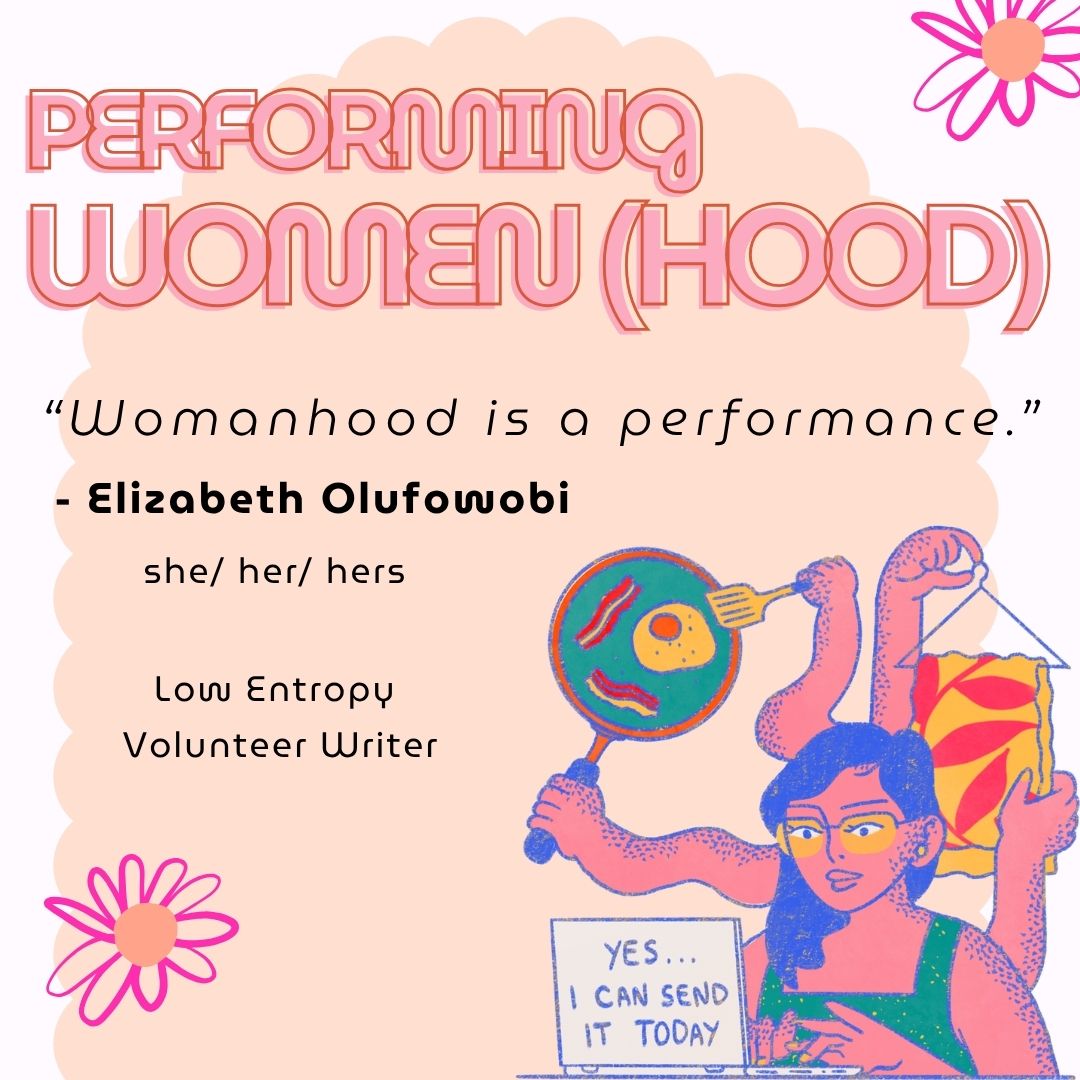
Elizabeth Olufowobi (she/her/hers), Low Entropy Volunteer Writer
This article was composed with the assistance of artificial intelligence.
When I was eight years old in Nigeria, during lunch, my female friends would gather into a circle and we would all scream out the parts we wanted to play. The options were mother, baby, daughter and dog. The parts were ordered, even then, by who mattered. We were playing “house.”
I did not know it then, but we were rehearsing for our lives. We saw women and little girls play the parts of mothers in our homes, on TV, at school, in churches. The media didn’t explicitly state women’s roles, but we noticed women in the kitchen before dawn; women staying behind men in conversations; women “knowing” their place in positions of authority; women managing the household without really managing them, for the man was in charge; women being docile, patient and submissive; women acting like dogs, on all fours at a man’s command.
This was repeated in my church. Proverbs 31 woman. Proverbs 31 woman. Proverbs 31 woman. The Bible passage became like an earworm every May. Women of all kinds were encouraged to pay attention to the words of the female pastor, the only day when she was allowed to preach, as she told you how to become as gracious, kind and strong as she was. The secret? Being submissive. Stop arguing. Be quiet. Don’t anger your husband. Don’t be stubborn. Being a Proverbs 31 woman was marketed as a way to be the type of woman Paul would be proud of and men would go to war for. The Proverbs 31 woman, if she does all these things, is more precious than rubies.
Children sang those passages fervently and passionately. Men yelled out those passages, barely hiding their contempt for their wives.
As a Pentecostal Christian at that time, I felt like I had to become this woman. I tried to wake up by dawn, manage my household and be productive. With each failure, my mind kept repeating the same thing: You are not a godly woman.
Then came Canada. Snow. Fairer skins. New accents. Fairer skins. A new, familiar type of loneliness. Fairer skins. As my world changed, so did my understanding of who a woman was. I had to be ambitious, empowering, but not threatening. For my sisters watching, for my parents watching, for the Canadians watching, trying to judge if I belonged. I had to perform. I had to be a feminist, support my sisters, fight for our equality, for our right to be free, but to do it without being too loud. I had to be beautiful—at school, at church, in public—but not too beautiful where it would stir up jealousy or lust. Pure in my looks. Intelligent, but not too confident, not too cocky. So I rely on self-deprecatory humour to blend in.
Womanhood is a performance.
To be a woman is to perform in a circus. Your job: entertain men and society. Juggle men’s emotions—anger, lust and unfunny jokes—in one hand. In the other, cultural expectations that change every few years. You have to walk the tightrope without disturbing patriarchal lovers, faith believers and feminine energ-iers. Don’t be “too much.” Oh, and let’s not forget to smile.
But the thing is, you are not a performer. You’re ordinary. You’re unskilled at this. You are just a woman.
So we’re left with two options really: fall or adapt. Which do we choose?
I see my other sisters on the same tightrope, pushing, shoving for the limelight. I see this in my role models. The ones I listen to, the ones on my screen. They call each other names and manufacture drama. They participate in a war among women because we’ve never been taught how to relate to one another. Impressionable young women watch them. I see this in myself when I compare my GPA, accomplishments and social standing to those of women I admire. I compete against women I admire.
It’s cruel: we’re told to have each other’s backs, but patriarchy hands us knives to stab each other with. If she falls, there is one less competitor. We’re measured by checkmarks: who is prettier, whiter, skinnier, more feminine, more docile, more witty, sexier, curvier. There is always more to add at the end of the page.
But I ask myself: if patriarchy worked for me, would I be against it, or would I enjoy it? The perks religion and society sell to me seem shiny. I imagine the attention of rich, masculine men. Admired. Blessed by God. Surrounded by godly children. The American Dream.
I’m learning you cannot win by trying to be everything to everyone. I feel exhausted seeing who I am supposed to be every day on social media, at school and in my community. You can’t be perfect and satisfy everyone. Right?
I just want society to accept me for who I am.
I want to have friends without feeling the need to compare myself to them.
I want to laze around all day, eating donuts without feeling that I will be less desirable and called fat.
I don’t want to be expected to cook for a man and clean, as if that is all I am worth.
In the end, all I, Elizabeth Olufowobi, want, is to breathe and be a woman, whatever that looks like for me.
I just want to breathe.
—
Elizabeth Olufowobi is a university student and aspiring writer based in Calgary. She writes about identity, community and the emotional chaos of growing up. When she is not watching grass grow, she is probably reading, drawing or experimenting with music genres.