
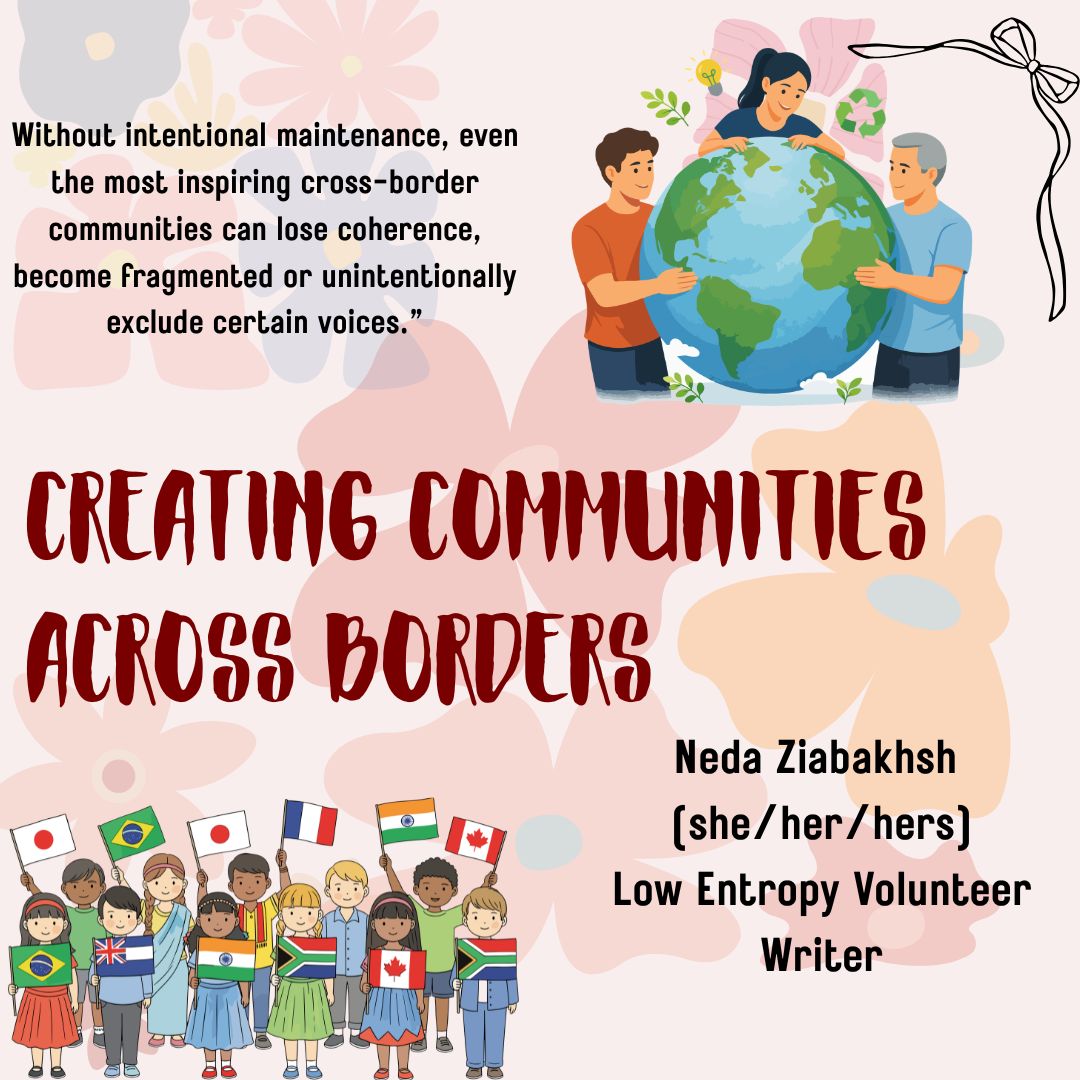
Neda Ziabakhsh (she/her/hers), Low Entropy Volunteer Writer
This article was composed with the assistance of artificial intelligence.
Creating communities across borders is often celebrated as a meaningful achievement. It represents shared purpose, collective energy and the belief that people can remain connected, despite differences in geography, culture, language or background. Yet while much attention is given to how cross-border communities begin, far less is said about what it takes to keep them alive. In reality, the most challenging and consequential work of community building begins after the initial excitement fades.
Communities that span borders are rarely formed in silence. They emerge from conversations, shared concerns, creative collaborations or common needs that transcend physical location. Technology, migration, education and global challenges often bring together people who might otherwise never meet. In the beginning, participation feels natural and hopeful. People show up with enthusiasm, driven by curiosity and optimism, motivated by the idea of connection beyond boundaries. There is momentum—but momentum can be deceiving. It can create the impression that a community, once connected, will sustain itself without further effort.
However, communities across borders are not self-sustaining systems. They are living, human networks that require even greater care, attention and adaptation than singular communities. Differences in time zones, communication styles, language fluency, cultural norms and access to resources can slowly affect participation and engagement. Without intentional maintenance, even the most inspiring cross-border communities can lose coherence, become fragmented or unintentionally exclude certain voices.
Maintaining a cross-border community begins with recognizing that participation must be actively supported, not assumed. Clear communication channels, inclusive decision-making processes and flexible engagement methods are essential. This may mean offering multiple ways to participate, being mindful of scheduling across time zones or adapting language and formats to ensure accessibility. When expectations are transparent and responsibilities are shared, members feel safer contributing in ways that fit their realities. When these structures are missing, the burden often falls on a small number of individuals, increasing the risk of burnout and disengagement.
Listening becomes especially critical across borders. Strong communities are built not only by speaking, but by deeply listening, particularly to perspectives shaped by different cultural, social or political contexts. Misunderstandings are more likely when people bring diverse assumptions and experiences to the same space. Open dialogue, regular feedback and a willingness to learn from differences allow cross-border communities to grow, rather than fracture. Listening with humility helps transform diversity from a challenge into a strength.
Trust remains the foundation that holds everything together. Across distance, trust develops through consistency, reliability and respect. It grows when commitments are honored, communication is clear and challenges are addressed openly, rather than avoided. Conflict, when approached with care, can strengthen understanding and clarify shared values. When ignored or mishandled, however, it can quietly weaken relationships and participation, especially in communities where members may already feel distant or disconnected.
Recognizing limits is also key to sustainability. Cross-border community work often depends on unpaid labor, emotional investment and invisible coordination. Expecting constant availability across different regions and life circumstances is neither realistic nor fair. Healthy communities respect boundaries, encourage shared leadership and normalize periods of rest or reduced engagement. They understand that participation may fluctuate over time and place, without equating absence with lack of commitment.
Equity and inclusion across borders are not achieved through intention alone. They require ongoing reflection on power, access and representation. Communities that regularly ask who feels welcome, who feels heard and who may feel distant are better equipped to grow ethically and sustainably. This reflective practice strengthens accountability and reinforces shared values over time.
Ultimately, creating communities across borders is an act of vision. Maintaining them is an act of long-term commitment. The reward is not immediate or easily measured, but it endures through trust, resilience and a sense of belonging that transcends geography. In an increasingly interconnected world, the ability to nurture and sustain such communities may be one of the most meaningful forms of collective work we can undertake.
—
Neda Ziabakhsh is a community-oriented designer, educator and sustainability advocate based in British Columbia. As a Low Entropy volunteer writer, she is interested in how thoughtful systems, inclusive practices and long-term care contribute to resilient communities.
nice