
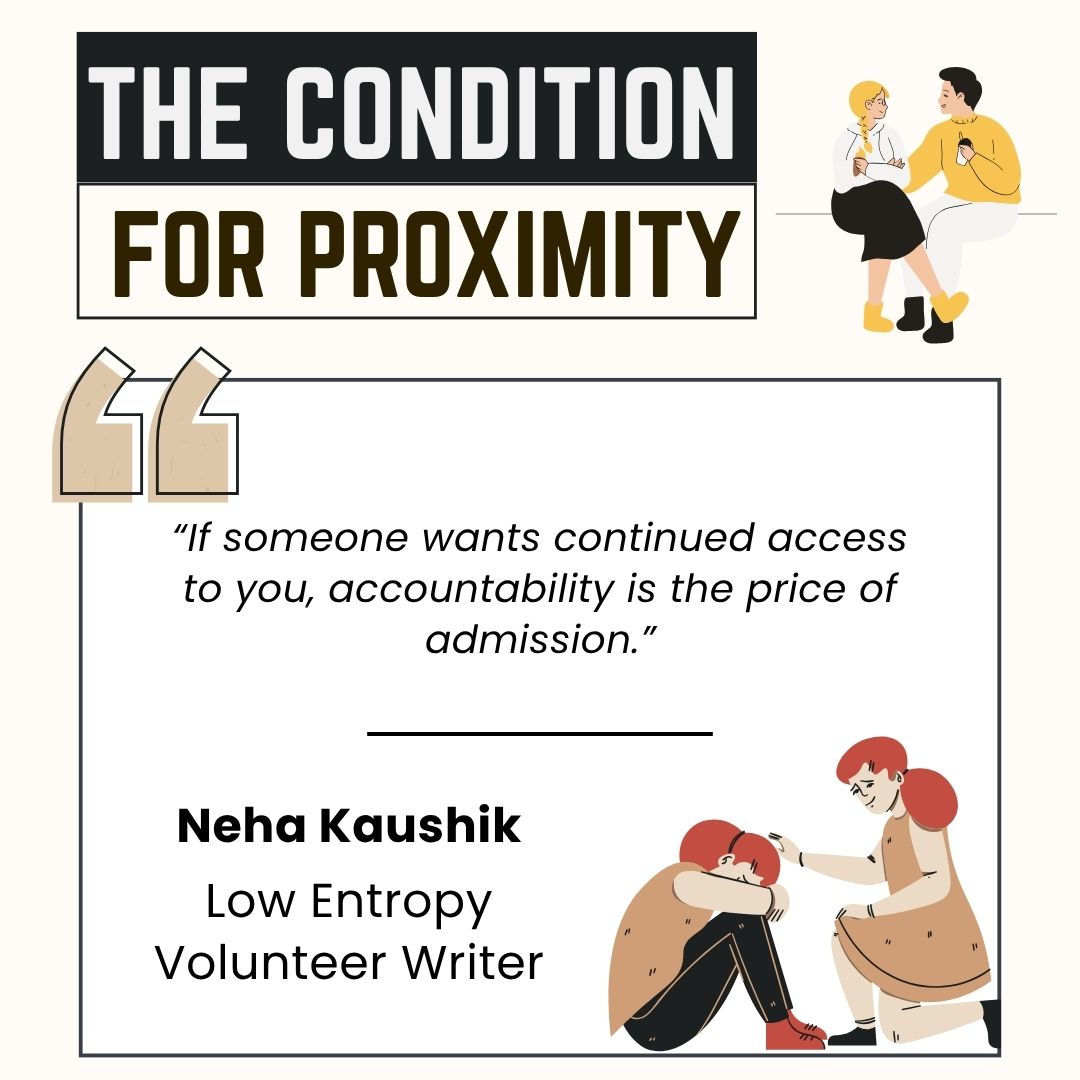
Neha Kaushik, Low Entropy Volunteer Writer
We hear it all the time: “People change.” “Don’t hold the past against them.” “Give them a fresh slate.”
Beautiful ideas in theory—but in real life, they often cost people their self-respect.
Because people do not only have intentions—they have track records.
And a track record is not the enemy of forgiveness. It is the evidence you use to protect your life.
So, why does track record matter?
Because what someone repeatedly does matters more than what they promise.
- If someone has a history of going silent when conflict appears—that is data.
- If someone repeatedly apologizes but nothing changes—that is data.
- If someone shows up for you only when they need something—that is data.
Data is not drama.
Remembering is not bitterness.
It is simply refusing to be blind on purpose.
What “remembering” is not
Remembering someone’s track record is not about revenge or keeping score. You are not cataloguing sins to punish them—you are assessing risk.
It is not about “You hurt me in 2019 so I will never forgive you.”
It is about “You have shown me the pattern. I now get to choose how deep a role you get in my life.”
That is not bitterness. That is adulthood.
The Past: Do not erase what educated you
Past relationships, friendships and family dynamics taught you something. Maybe they taught you that you settle quickly. Maybe they taught you that you over-give. Maybe they taught you that you tolerate disrespect when love is on the line.
You do not “move on” by forgetting.
You move on by remembering accurately—and refusing to reenact.
Before entering any new relationship—romantic, professional, friendship—check your internal archive:
- What have I historically ignored that later cost me?
- What were my early red flags that I rationalized away?
- What kind of behavior do I now know is non-negotiable?
That memory is not a wound—it is armor.
The Present: Measure, don’t fantasize
In current relationships, people often do one of two things:
- Forgive too fast and hope real change will follow, or
- Hold people hostage to their worst mistake.
Both are extremes. A more mature approach:
Keep an eye on the pattern.
Not on the apology. Not on the potential. Not on the fantasy version of them that you’re in love with—on the pattern.
Ask yourself:
- Are they doing consistent repair, or only episodic regret?
- Do their corrections survive three weeks, or only three days?
- Do they change only under threat of losing you, or on their own?
If someone wants continued access to you, accountability is the price of admission.
The Future: Your boundaries shape your relationships before they exist
Future relationships do not begin when you meet someone new.
They begin when you decide what you will and will not carry forward.
If you build a life where
- patterns are remembered
- second chances are conditional on visible action
- your self-respect is not up for negotiation
. . . you automatically change the quality of who stays and who leaves.
People with poor track records usually thrive where there is amnesia.
People who are capable of repair thrive where there is accountability.
Your memory selects your circle long before intimacy begins.
What happens when you ignore track record
Most people don’t get hurt because they “didn’t know.” They get hurt because they knew and overrode it.
We override because we want the relationship to work. We override because we are tired of starting over. We override because love makes us generous to the point of delusion. And that is precisely why memory must be deliberate—not passive.
When you ignore track record, you unconsciously sign up for the sequel of something you already survived. And sequels are always more expensive than the original—because this time you walk in aware.
The future built on accountable memory
A life built on this ethic—remember, assess, require evidence, protect dignity—produces different outcomes over time:
- You stop confusing intensity for intimacy.
- You choose people for their behavior, not their potential.
- You recognize early what used to take you years.
- You invest in mutuality rather than fantasy.
- You stop losing yourself to keep others.
This is how the past stops scripting the future. This is how self-respect and connection coexist. And this is how relationships stop being arenas of repetition and become places of evolution.
Because accountability is not the enemy of love—it is the condition that makes love safe to receive.
But what about compassion?
Compassion is not the absence of accountability.
Compassion is: “I believe you can change—but I won’t bankroll the time it takes if the cost is me.”
People are allowed to rebuild trust.
You are allowed to require evidence.
Growth and discernment are not enemies—they are companions.
The simplest rule
When someone shows you a pattern, don’t debate it with your hope.
Accountability is not a punishment—it is the condition for proximity.
Remembering is not spite—it is self-respect.
And track record is not a verdict—it is a forecast.
The most loving thing you can do for your future self is to stop treating history as a suggestion.
Because people change—yes.
But people also repeat.
Your life will be determined by which of those two truths you respect.
—
Leave your thoughts for Neha in the comments below. You can also follow us on Facebook, Instagram, TikTok, Twitter and YouTube to stay up-to-date with Low Entropy news!