
Macey Ragon, Low Entropy Volunteer Writer
Being a woman is expensive, and the pink tax further proves it.
While males can generally get away with a cheap 3-in-1 body wash, a basic face wash routine, deodorant, and, hopefully, a generic toothbrush and toothpaste, females require much more. For shiny hair, a healthy scalp and moisturized skin, we go for hair washes that contain no hormone-disrupting parabens, oil-stripping sulfates or irritating fragrances, which cost a pretty penny. Same for our faces: we search tirelessly for products packed with naturally derived ingredients, such as squalane for a protected skin barrier and hyaluronic acid for maintaining moisture or vitamins, vitamin C for brightening and niacinamide or vitamin B3, for skin texture, all of which are especially costly. Not only do women need a quality face wash, but also scrubs, serums, oils, moisturizers, toners and more. We are mindful of ingredients in body wash, lotions, body butters, body oils, deodorants, shaving products and even spray tans! Sometimes we spend more on razor blades that are allergy or sensitive-skin-safe, or cut out shaving altogether and pay money for laser hair removal, which requires multiple pricy sessions. The pressure to maintain a youthful look can be daunting and ridiculously expensive! Because women desire ethically made feminine products that often also have a “pink tax,” females tend to spend about 50% more on personal goods than males.
But let’s say we didn’t spend money on high-dollar quality commodities. Let’s compare similar products aimed at men and women. At my local Walmart, you can buy a pack of five pink Equate razors for $1.00, meaning for 10, you would pay $2.00. However, Equate also sells a 12-pack of men’s blue Equate razors for $1.96. Both include razors with 2 blades each, plus the men’s blue ones have a pivoting head. So, with the blue Equate razors, you get more razors for less, plus a pivoting head, versus the pink ones, which don’t have one but still cost more.
Moving on to body wash, men can choose an 18-fluid-ounce Suave 3-in-1 body, face and hair wash for $2.97. Three products essentially for the price of one. Alternatively, women can get an 18-ounce body wash, JUST a body wash, for the same price. Meaning, if we want a hair wash and face wash as well, we must pay extra for separate products. So, even when attempting to be frugal, females are forced to pay more.
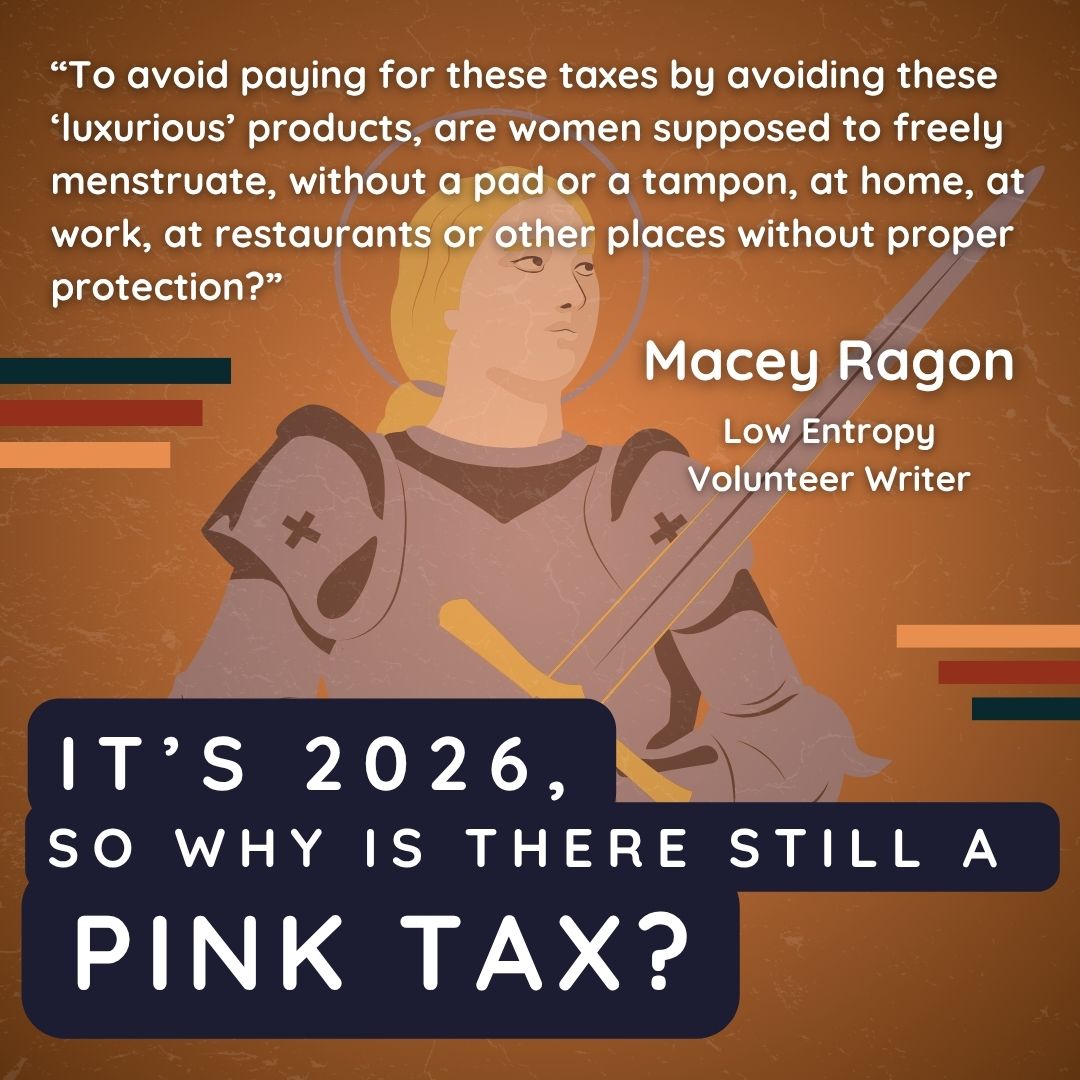
Let’s not forget that female consumers are obligated to buy “non-essential” taxable feminine products. The definition of essential is “a thing that is absolutely necessary.” So a non-essential thing would be something that is not absolutely necessary, right? These “non-essential” goods are also classified as a luxury and subject to a “luxury tax”. Do men believe women wake up and decide today we’re menstruating, as if it’s a choice? Do they really believe menstruating is a “luxury”? To avoid paying for these taxes by avoiding these “luxurious” products, are women supposed to freely menstruate, without a pad or a tampon, at home, at work, at restaurants or other places without proper protection? Is it not necessary to wear these products to prevent bleeding, which, in the medical field, is classified as a biohazard, everywhere we sit? Or are we meant to take time off work for one week every month to allow our menses to flow freely and use up valuable personal or sick time, if we even have the luxury of accruing it?
Apparently, if it’s not a problem for a man, it’s not a problem worth investigating. Did you know more research goes toward men’s cancer than women’s? Or that more funding goes towards erectile dysfunction, a dysfunction that a man can live with but would rather not, than women’s issues, such as fibroids, polycystic ovary syndrome or endometriosis, which are severely damaging to our health and potentially threatening to our lives? If something is not essential for a man, it must not be necessary for everyone; therefore, pads, tampons, cups and period underwear are wrongfully categorized as non-essential. Eighteen states, mainly in the South, such as Alabama, Arkansas, Georgia and Mississippi, still enforce the pink tax. The governing bodies of these states, which are all predominantly run by males, view female products as non-essential. So they continue to enact a tax, endearingly nicknamed the “pink tax,” to remind women how men capitalize on what little they understand of our biology.
Continuing the pink tax is discriminatory and unethical. It proves how those in power, who are mostly men, do not value women. To top it off, they force women to pay more to be undervalued citizens by keeping the pink tax. Females still earn less than males, and somehow, we still pay more to take care of ourselves, too. It’s 2026. Why is there still a pink tax?
—
Leave your thoughts for Macey in the comments below. You can also follow us on Facebook, Instagram, TikTok, LinkedIn and YouTube to stay up-to-date with Low Entropy news!