
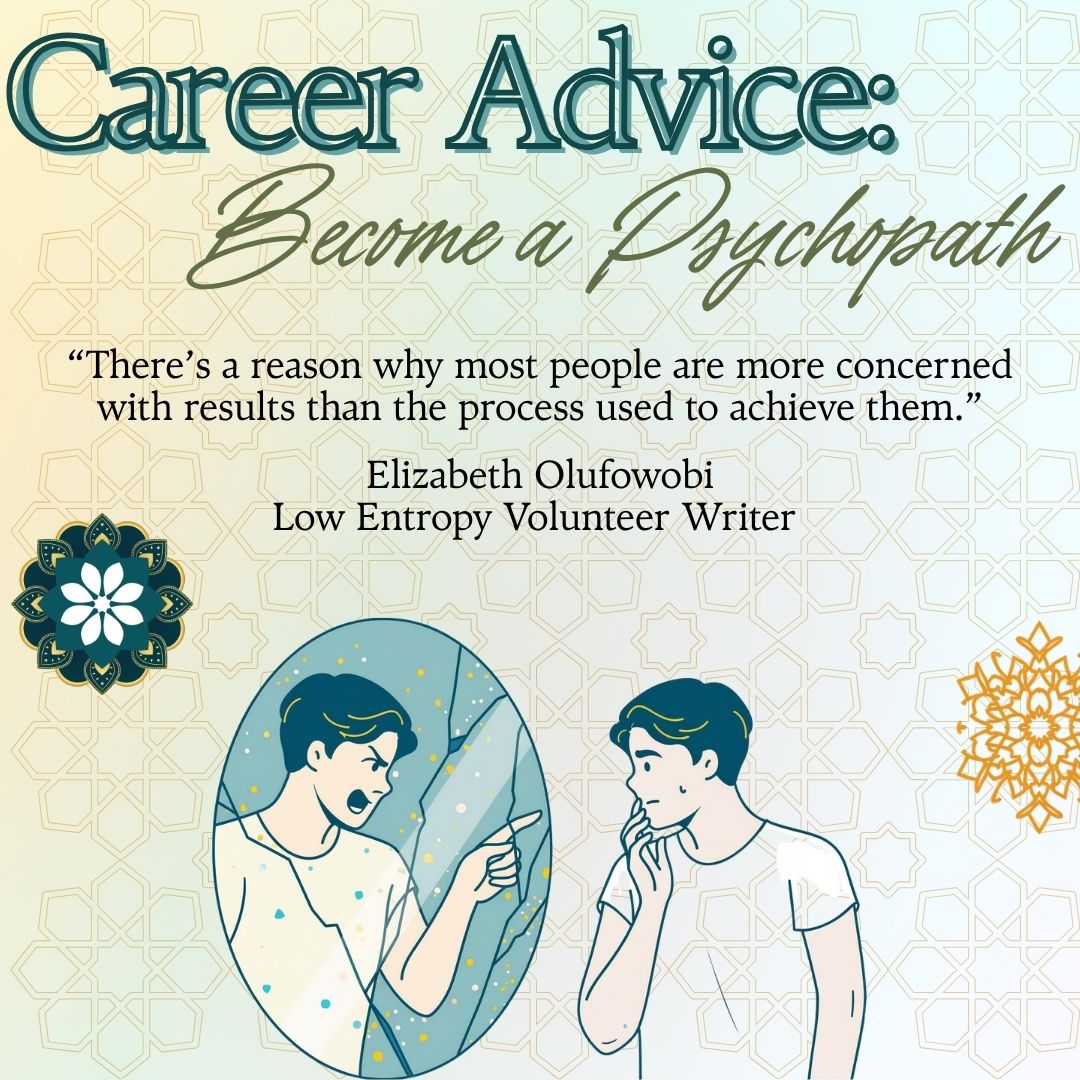
Elizabeth Olufowobi (she/her/hers), Low Entropy Volunteer Writer
This article was composed with the assistance of artificial intelligence.
A psychopath is typically someone who chooses to manipulate people, pursue their own interests relentlessly and feel little to no responsibility for the harm they cause. So let’s see why we should be one . . . for a thought experiment.
Let us be real with ourselves about what we don’t like to say out loud—but what reality keeps forcing us to confront: being a good person is not a reliable strategy for being successful in life. We say it is. We teach our kids this lesson. We build our entire moral compass around it. And we have been quietly indoctrinated—by parents, teachers and self-help gurus—into this lie.
Because the world we live in rewards something else entirely—something ruthless, something indifferent, something unapologetic, something that can benefit from others without being weighed down by them: someone psychopathic. If the goal is to win, to rise, to be seen and remembered, to be envied, to “make it,” then the real question isn’t “how do I work harder and achieve more?” Rather, the true question is “how much of my humanity am I willing to trade?”
With my completely unverified scientific genius, I’d estimate you need to get rid of about 87.9% of your morality.
One may argue that it is possible to be successful without becoming . . . evil. You just need to follow the formula: work harder, stay disciplined and be consistent. Once you have completed this rigorous training, success will reward you with her presence. It’s a comforting, clean and fantastical piece of bullshit. This “formula” doesn’t show you the whole picture—only the shiny parts.
Because success, as we practice it, has very little to do with moral integrity and more to do with affluence, influence and recognition. It looks like building something massive—an app, a company or a brand—and being known for it, not caring about the bodies your product was built on. There’s a reason why most people are more concerned with results than the process used to achieve them.
The stories of companies like Amazon, Facebook and McDonald’s are often painted as stories of innovation, genius and perseverance. But behind these stories lies something we don’t want to acknowledge: these companies operate with psychopathic tendencies. Their concern is how to extract, exploit and train human behaviour for profit. And we naively point to these outcomes as motivation for our children, telling them they too can become the next success story—without realizing that, for many, that level of success may require giving up parts of their humanity.
Our society teaches cooperation, but rewards domination. We quote morality, but operate on incentives and bribes. Religious teachings like Philippians 2:3-5 encourage humility and selflessness and 1 Thessalonians 5:11 calls for mutual encouragement. But those values rarely align with the behaviours required to gain power. Instead, we see something closer to Judas Iscariot–a willingness to trade loyalty for immediate gain, just in more polished and socially acceptable forms.
And when harm does occur—especially in places where leaders are supposed to protect—it rarely stops the people responsible. Power protects power. Wealth absorbs consequences. Influence reshapes the narrative. Entire industries can engage in questionable practices and continue to grow, because the system is not built to punish success—it is built to sustain it.
We ignore the reality that not everyone is starting from the same position. Some are born into wealth. Some are born with connections. Others are born into systems designed to keep them at a disadvantage. Your race, gender and class can either be the greatest advantage you’ve ever had—or the very thing working against you. These structural realities shape outcomes long before effort ever enters the equation.
Systems like capitalism and patriarchy keep resources concentrated at the top and reinforce themselves. The wealthy stay wealthy. The connected stay connected. The rest are told to run faster. It starts to feel less like a race and more like a performance: one where everyone pretends the rules are fair.
And if the rules aren’t fair, then something magical happens. What if you learned to make the system less unfair for yourself and more unfair for everyone else? At that point, “psychopathy” starts to look less like a disorder and more like a strategy.
Psychopathy doesn’t emerge randomly. It persists because, in certain environments, it works. And as this article has been hinting at, from an evolutionary perspective, the traits that survive are not the most moral but the most effective. If a lack of empathy allows someone to navigate a competitive, unequal system more efficiently, that trait doesn’t disappear.
And everyone else is told by these same systems to keep trying. To work harder. To stay kind. To believe that eventually, the system will reward us. This isn’t a fair fight. It’s not even a fight. It’s King Kong swatting a mosquito. And when King Kong wins—as he usually does—we don’t question the system. We question the one who lost. We tell them to try again. As if effort alone were ever the deciding factor.
Maybe the real problem isn’t that people are becoming more ruthless. Maybe the problem is that, in a system like this, ruthlessness starts to make uncomfortable sense.
And if that’s true, then the question isn’t whether someone should become a psychopath.
It’s why they wouldn’t.
—
Elizabeth Olufowobi is a university student and aspiring writer based in Calgary. She writes about identity, community and the emotional chaos of growing up. When she is not watching grass grow, she is probably reading, drawing or experimenting with music genres.