
Karen Susan Turi (she/her/hers), Low Entropy Volunteer Writer
“Some people aren’t just missing an odd screw; the whole toolbox is gone.” – Anonymous
If someone wakes up on a bright blue day and decides they’ll try being a psychopath for a day, they’ll need to do some brain rewiring.
∾
Somewhere across the global internet expanse, a finger is hovering over a white arrow on a thumbnail, hesitant to find out whether they’re a narcissist or not.
The thumbnail shows a shadowy, scowling face in the foreground, with red laser beams for eyes, set against a backdrop of hunched, cowering figures with hollow eyes, pleading for mercy. It promises a checklist to put a worrying mind to rest, and dispel the fear that all this time it has really been them, the narcissist. But the fear of discovering the truth, even by suspicious clickbait, is compelling and scary, but strangely comforting. Then they’ll finally have answers to accusations by scorned lovers and estranged family members of them being a narcissist, and they’ll maybe own it. Self-discovery can be both debilitating and a catharsis towards reinvention: if the discovery doesn’t kill you, it’ll make you wiser.
But narcissists don’t discover they’re one, as they lack self-awareness, it’s been said.
Uncovering one’s own narcissism disputes the science that narcissism can be cured through self-reflection; therefore, the video serves to reassure the navigator’s sanity rather than to confirm fears.
Having clicked on the thumbnail, the navigator begins a perilous mental conversation, ticking off the times they engaged in gossip, felt no remorse, avoided being outed, told white lies or lied by omission. Their ego steps in to defend, deflect and find excuses justifying past transgressions as normal or understandable behaviour. The navigator makes a mental note of these protective mechanisms.
The initial apprehension wears off as the navigator completes the checklist, confident that they’re not a narcissist, though it triggers an algorithmic deluge as videos cascade down the sidebar. The Dark Triad. Sociopath. Malchevelli. Am I a psychopath? one blares, seeking engagement.
Wrestling between maintaining blissful ignorance and curiosity, the navigator succumbs to the latter, though this time they’ll Google it. A.I. intercepts and offers illuminations: many psychopaths are not loners but seemingly well-adjusted social chameleons hiding in plain sight. White collar criminals. The navigator scrolls down the page for a digested analysis: superficial charm, no remorse or guilt, manipulative and reckless behaviour without thought for consequence, lack of fear or anxiety. Shallow emotions.
They reflect on the time they knowingly rode their bike in the wrong direction on the bicycle path; the time they felt numb, unable to shed a tear after their mother died. The time they went hiking in the hills wearing Crocs instead of hiking boots.
Their deductive mind suddenly interrupts this stream of thought. It’s been a week since they watered their plants. The bird feeder is empty except for shells of seeds stuck to the sides. They have bills to pay and a birthday gift to get for a friend of a friend. They’ll need more than clickbait to self-diagnose and challenge such painful normality.
A thread begins to unravel, a question popping into their head spontaneously: Do psychopaths harm plants? The navigator broadens their research, typing the question into the search bar. No studies on that, it seems, but a hypothetical deductive argument that psychopaths are about destruction, not creation. Therefore, they deduce, a plant can be an innocent victim of a psychopath.
The navigator thinks back to any time they might have left a plant to shrivel up and perish out of morbid curiosity, or delighted in a skinny, hungry squirrel begging for nuts at their snowed-in door.
Nourishment, Care, Creation.
They look at an unfinished tapestry, they’re busy weaving on a small wooden loom, the ripple of textures, colours and fringes inviting touch. A tray of pearls and tiny crystals, wire and clasps sits on their worktable in the corner, a jewelry project frozen in time in anticipation of adornment to enhance someone’s natural beauty.
The thread unravels a little further.
A suffering soul is diagnosed through biological traits, not feelings, says Wikipedia. An underactive amygdala. An impaired prefrontal cortex.
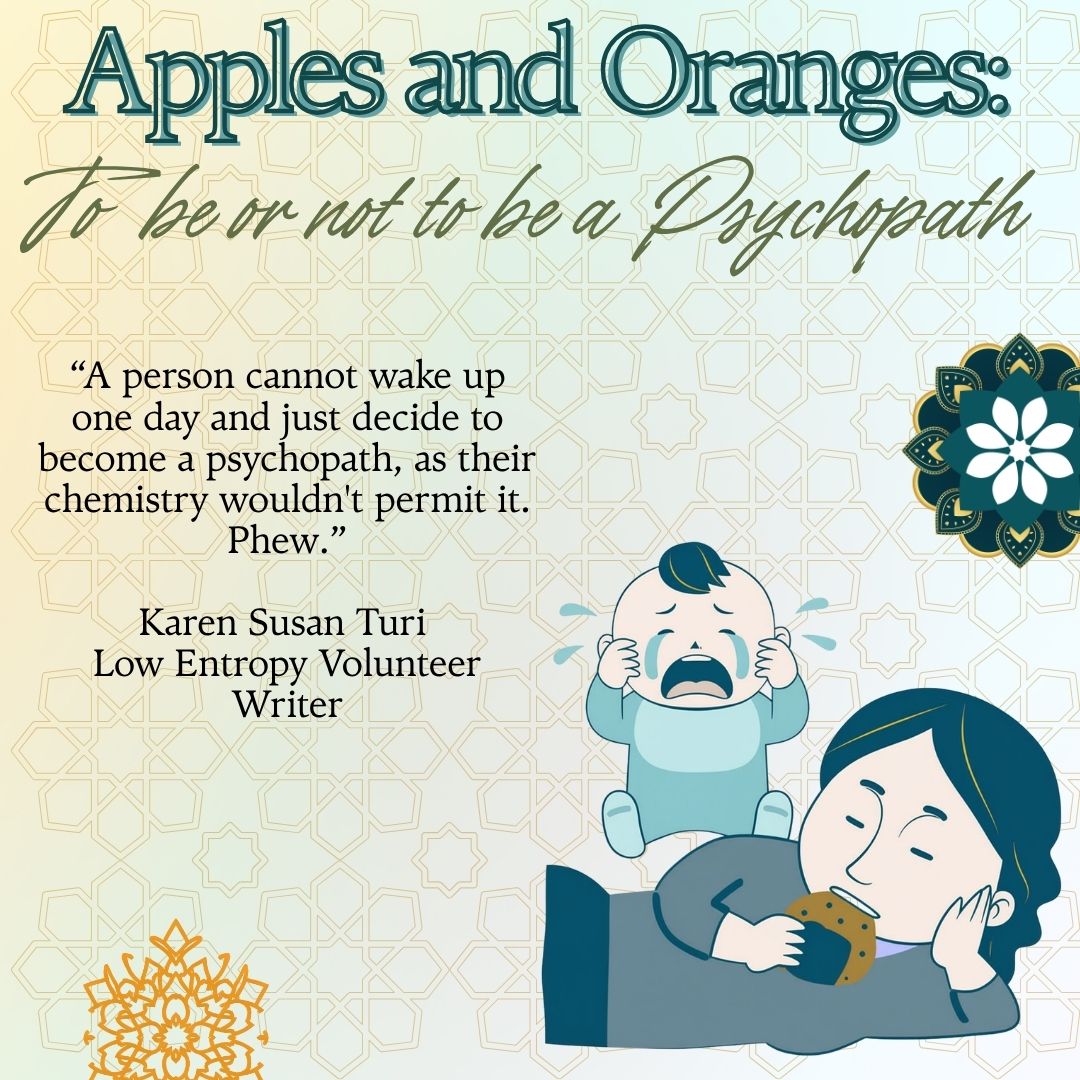
A person cannot wake up one day and just decide to become a psychopath, as their chemistry wouldn’t permit it. Phew.
The navigator breathes a sigh of relief at the apples and oranges conclusion. But another question is bugging them:
Could a pharmaceutical lab worker conducting experiments on lab animals be considered a psychopath? even if their job is for the benefit of mankind?
This will be a critical thinking journey for another day.
—
I am an illustrator, writer and painter living near the shores of the temperamental Milles Isles, Laval, QC. I spend my time thinking, dreaming and creating, come rain, snow or shine.