
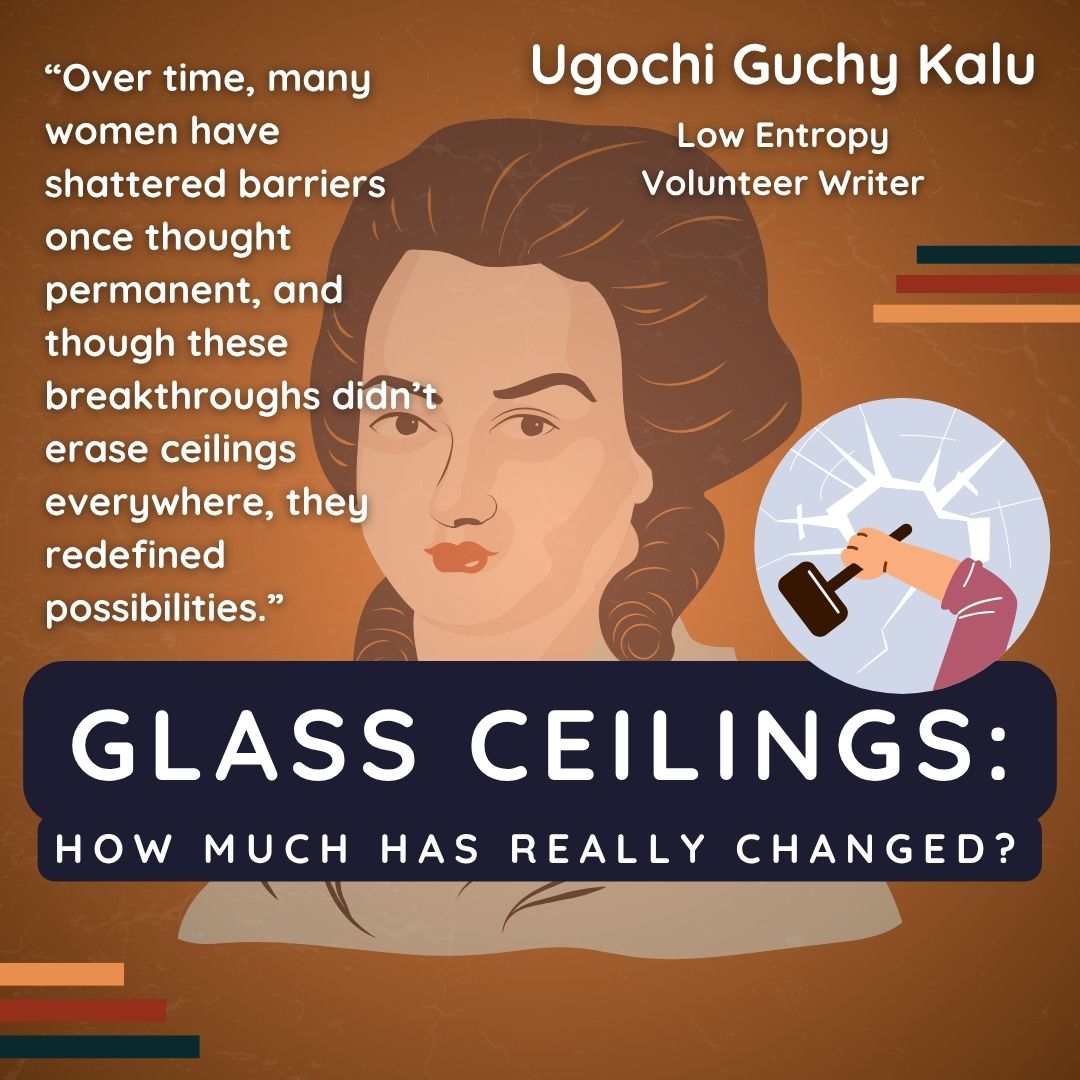
Ugochi Guchy Kalu (she/her/hers), Low Entropy Volunteer Writer
My first real curiosity about gender equality and equity, particularly in the Nigerian context, began when I learned about Funmilayo Ransome-Kuti. Growing up, she was generally introduced to us with what felt like an oddly trivial distinction: she was popularly known as the first Nigerian woman to drive a car. Even as a child, my young mind found it very funny as to why driving a car could be considered an accomplishment worthy of news. I revisited the life of Funmilayo as a grownup who is now conscious of the bias and underrating of female-lived experience, and how society tries to bury female accomplishments or casualize them.
Upon learning that the great Funmilayo did not only drive cars, but she was also a trailblazer-anti-colonial activist who led women to protest unfair taxation, which forced the temporary abdication of the then leader of state. She was a prominent figure in Nigerian independence and led the women-only movement delegation to London.
Funmilayo was an advocate and campaigned for women’s suffrage and education, and was the first woman in Nigeria to be awarded the Lenin Peace Prize. She was known for her defiance against patriarchal and colonial rule, yet society tried to relegate her accomplishments to simply driving cars.
Since the term glass ceiling was coined in 1978, it has become one of the most powerful metaphors for gender inequality in the workplace. Yet, more than four decades later, many women still find it uncomfortably real. Over time, many women have shattered barriers once thought permanent, and though these breakthroughs didn’t erase ceilings everywhere, they redefined possibilities.
Women have made their marks in STEM, media, culture and business. Names such as Marie Curie, Ada Lovelace, Indra Nooyi, Mary Barra, Jane Fraser, Oprah Winfrey and Sheelagh Whittaker resound in history books as some of the first women to shatter ceilings in their respective fields of endeavor. However, in today’s workforce, we hear fewer and fewer names of females being “first” in anything existing or new. This begs the question: is our society regressing or progressing?
Globally, wage and opportunity gaps are as wide as the Grand Canyon with no immediate actions by nations to close this gap. The finance, tech and energy sectors remain heavily male-dominated, and women still earn less than men in similar roles, contributing to lifetime economic inequality, and full parity is not expected until 2086 at current rates. Of course, this is a mere wish, I wouldn’t dare hold my breath.
I remember vividly the responses I received from people when I shared the fact that I did in fact hold a bachelor’s degree in physics. Interestingly, that response is the same today as it was years ago when I was in school. I was often met with comments like “Are you sure?” “You mean physical education?” or condescendingly asking which university I attended, as if knowing the university made it any less true or more deserving. It’s almost impossible for people to accept, mainly because I am a woman and science, especially physics, was meant for men.
Wherever that assumption came from, it points to the fact that glass ceilings already shattered still have their shards deep in our skins, cutting and draining us as we struggle to crawl out from the now seemingly ceiling-less building.
These ceilings persist as no fault of any single policy, but by cultural and structural factors requiring bias evaluation even where anti-discrimination policies exist, because who is really policing these policies? The related phenomenon of the glass cliff reveals that women are sometimes pushed into leadership when failure is high-risk, making them scapegoats and equity harder to attain.
The glass ceiling isn’t what it once was in a world where women lead countries, corporations and global movements—but it’s still here in quantitative terms. It’s thinner and more visible, yet not broken for many women. The question that begs an answer isn’t just “Has the glass been cracked?” but “How do we turn these cracks into open doors?”
—
My name is Ugochi Guchy Kalu, and my belief is that change will require continued commitment to structural reform, bias interruption, equitable policy, dismantling the patriarchy and a reset in global mindset that sees women’s leadership not as exceptional, but as expected.