
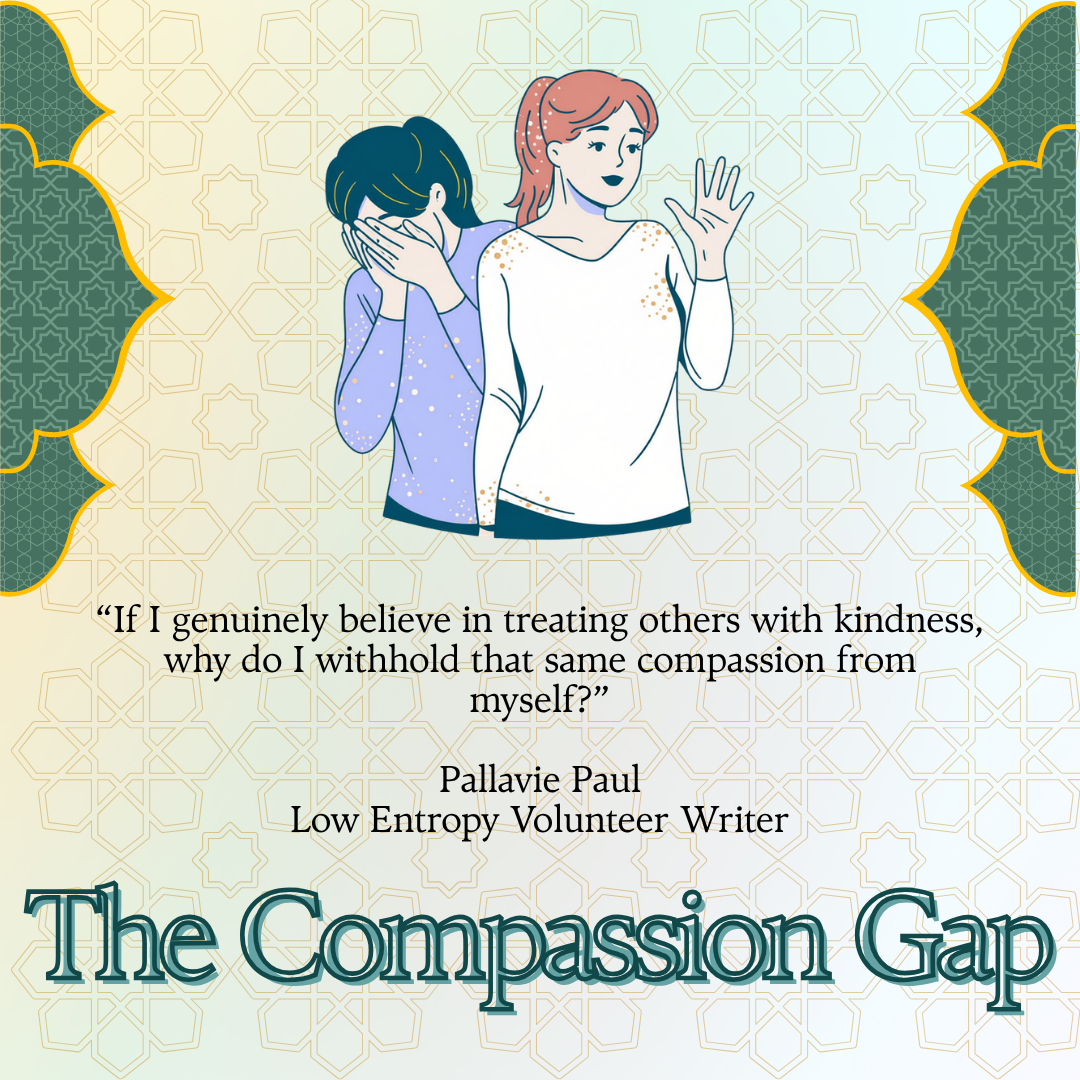
Pallavie Paul, Low Entropy Volunteer Writer
There is a question I’ve kept circling back to for years, one I suspect I’m not alone in asking:
“If I genuinely believe in treating others with kindness, why do I withhold that same compassion from myself?”
It sounds almost too simple to be a real problem. And yet, for many of us, it is one of the most quietly persistent struggles we carry.
I grew up in an environment where mistakes were rarely met with patience. Small errors felt large. Over time, my nervous system learned to respond to failure the way it had always seen failure handled with criticism, urgency and a quiet pressure to do better, faster. I would tell others to be patient with themselves. I listened carefully when they were hurting. But when it was my turn to struggle, I became my own harshest voice.
It took me years to even notice the gap between how I treated others and how I treated myself. Once I did, I couldn’t unsee it.
This disconnect is more common than we might think, and it doesn’t happen by accident. Many of us were simply never taught that self-compassion was an option, we were taught that it was a form of weakness. We absorbed the idea that being hard on yourself is how you stay motivated, how you improve, how you earn rest. But research in psychology, including the work of Dr. Kristin Neff, one of the leading researchers on self-compassion, suggests the opposite: chronic self-criticism is more likely to lead to burnout and anxiety than to genuine growth. Motivation built on self-punishment tends to collapse under pressure, precisely when we need it most.
There’s also something worth naming about vulnerability. Sitting quietly with yourself without productivity, without distraction can feel surprisingly threatening. Many of us have been conditioned to associate stillness with failure, as though if we slow down long enough to feel something, we’ll fall behind. So, we keep pushing. And the inner dialogue gets harsher the more exhausted we become.
The shift I’m describing doesn’t require perfection. It begins with something much smaller: awareness.
Next time you’re going through something difficult, pause and notice how you’re speaking to yourself. Then ask: “What would I say to a close friend in exactly this situation?” Most people find, when they sit with that question honestly, that they would never speak to someone they love the way they speak to themselves. Not even close.
That gap between the tenderness we extend outward and the harshness we turn inward is where self-compassion begins. Not as a way of lowering your standards or excusing mistakes, but as a way of staying in a relationship with yourself even when things go wrong, choosing not to abandon yourself in hard moments.
Self-compassion also doesn’t mean you’ll always feel confident or positive. Not every day will feel like progress. Some days are genuinely hard, and naming that honestly is part of the practice. The goal isn’t to become perfectly self-assured overnight. It’s to slowly, imperfectly, close the gap between how you treat others and how you treat yourself.
Perhaps the way we speak to ourselves in hard moments matters more than we realize.
Perhaps it’s time to stop being the one person in your life who doesn’t receive your own kindness.
I’m still learning and navigating this. There are days when the old patterns surface the impatience, the self-criticism, the inner commentary that I’d be embarrassed to say out loud. But I notice it more quickly now. And I’m getting better at responding to myself the way I’d respond to someone I care about: with a little more patience, a little more curiosity and a little less judgment.
Maybe that’s where most of us are in the middle of learning.
What I’d love to open up, if you’re reading this, is a conversation. Do you notice a difference in the way you speak to yourself versus how you speak to the people you love? Has anything helped you close that gap?
I don’t think there’s one answer. But I do think we figure it out better together than alone which, come to think of it, might be its own small lesson in self-compassion.
—
Leave your thoughts for Pallavie in the comments below. You can also follow us on Facebook, Instagram, TikTok, Twitter and YouTube to stay up-to-date with Low Entropy news!